MOSA
SAURS
About Mosasaurs
As successful predators in the cretaceous period, mosasaurs were marine reptiles that were great swimmers!
Morphology and Body Plan
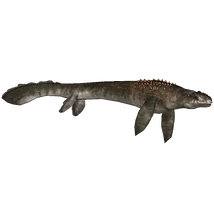
Mosasaurs varied in size depending on the species; some were as small as 8ft, and others as large as 50ft. The general body plan of a mosasaur included: a flat head, narrow anterior tapering long snout, upper and lower jaw with sharp teeth, short strong neck, slender trunk, long tail with caudal fin, short limbs with digits, flexible fin and some had scales like snakes. Their scales were diamond shaped, and overlapped one another.
The mosasaur had two types of scales:
Keeled scales - were non-reflective and protected the upper body. The matte finish of the keeled scales helped for sneak attacks on their predators.
Smooth scales - were found on the underside of the mosasaur and protected the lower parts.
Activity Corner: Puzzle Mania
Think you know how a Mosasaur looks? Try our Puzzle!
Adaptations
These predators had adaptations that allowed them to dominate the waters for a period of time at the end of the cretaceous period. These marine reptiles were completely adapted to marine life, and their body plan was constructed for rapid swimming! They were elongate and round bodied with a highly kinetic skull and jaw. They also had modifications to their axial skeleton with short finned limbs which assisted in their efficient swimming, which resembled the way crocodiles swim.
How Mosasaurs Swim
Check out this video made by XiOLA on how a mosasaurus is hypothesized to swim.
Taxonomy
It was thought that mosasaurs and snakes shared common marine ancestors. This is because of several features both of these animals shared, including flanged teeth of the palate, reduced limbs, similar style of movement and the hinged jaw which resembles that of a snakes.
After analysing mosasaur phylogenetics there are two evolutionary theories that disagree with each other. One states that mosasaurs should be organized as a monophyletic group (containing an ancestor and all its descendents) or a polyphyletic group (containing features that look the same but converged or reverted from different ancestors).